
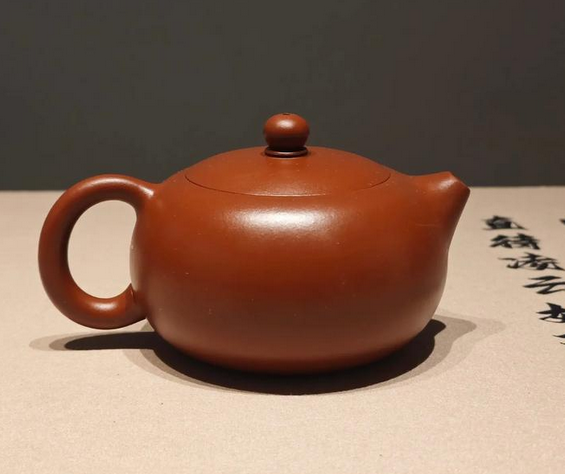

As the name suggests, the “Xishi Teapot” should be as beautiful as Xishi, or rather, the design of this teapot is inspired by Xishi. Therefore, the spout of the Xishi Teapot is short and rounded, which also echoes Xishi’s way of dealing with people—her cherry-like small mouth is external beauty, and her gentle speech that does not hurt or offend others is internal beauty.
The teapot lid is set off by a spherical knob, paired with a special curved handle and a short small spout, as if naturally formed. The Xishi Teapot has a soft and beautiful appearance like Xishi, with a dignified and elegant temperament. According to folk legend, during the Spring and Autumn Period, in order to defeat the State of Wu, Gou Jian, the King of Yue, decided to use the “beauty trick”—sending beautiful women to Fu Chai, the King of Wu, to dampen his fighting spirit. Fan Li, a senior official of Yue, took on this task. He traveled all over the State of Yue and finally found Xishi, a girl who washed silk by the river. At the same time, he fell in love with her at first sight. After all, Fan Li was a man who accomplished great things. With the country in peril, even though he loved Xishi, he still sent her to Fu Chai. Fu Chai was also deeply fond of this beautiful woman with the beauty that outshone the fish and who was skilled in singing and dancing. From then on, the king no longer held morning court, and the State of Wu gradually declined. In the end, the State of Yue conquered the State of Wu. At this time, Fan Li, who had made great contributions, chose to retire bravely, resolutely abandoned his official position and fled to Dingshan, Yixing with Xishi to live in seclusion.
The two either boated on lakes and seas, wandered in mountains and wilds, or walked in markets. Later, he found that the soil from Huanglongshan in the local area could be used to make pottery, so he taught everyone to collect soil to make blanks and build kilns to fire pottery. As the saying goes: “Everything is difficult at the beginning.” Although Fan Li successfully fired pottery, the products were either deformed (crooked pottery) or underfired (yellow pottery). For a time, Fan Li couldn’t find a solution.
One day, after washing rice, Xishi started cooking. Fan Li saw that the flame was very strong and shot high, thinking that this was a waste of firewood, so he took away the three stones under the pot. Xishi said, “If the pot presses directly on the fire, the fire won’t burn vigorously.” Sure enough, after the three stones were removed, the fire died down. Fan Li thought: If the clay blanks are not placed on the ground but suspended during firing, will they be easier to fire thoroughly? Following this method, the number of underfired pottery decreased. Later, people called these stones “kiln foot stones”. Another day, Xishi was cooking. While cooking, the rice pot boiled over. Xishi quickly took out most of the firewood from the stove, leaving only a few pieces inside. Fan Li asked, “Why did you take out the firewood?” Xishi replied, “After the rice boils, it needs to simmer—this is called ‘retaining heat’. If you keep burning it with a big fire, the rice will be undercooked if the time is short, or burnt if the time is long.” After Xishi retained the heat and opened the pot, the rice grains were as round as pearls. While eating, Fan Li suddenly thought: Isn’t firing pottery the same as cooking rice? Later, Fan Li tried this method and succeeded. He taught these techniques to the local people, and since then, the Dingshu kiln field has flourished. Therefore, purple clay artisans named this small and beautiful round teapot the “Xishi Teapot”, which contains memories of Xishi and Fan Li, and even a review of the history of purple clay!