
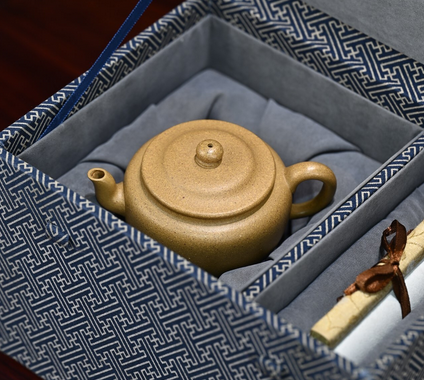

When hot water is first poured into a new Yixing purple clay teapot, a faint earthy smell wafts out. Many new collectors immediately panic: “Did I buy a shoddy chemical clay teapot?” There’s no need to worry at all! An earthy smell from a new teapot is most likely not a quality issue—instead, it may be a normal characteristic of genuine ore purple clay. A truly inferior teapot will emit a far more pungent odor than just an earthy smell.
I. Where Does the Earthy Smell Come From? 3 Normal Reasons, Unrelated to Poor Quality
The “ore clay nature” of the material itself
Yixing purple clay is extracted from deep ore veins in Huanglong Mountain, and it is essentially natural pottery clay. Even after crushing, aging, and kneading processes, faint ore clay scents still remain in the internal pores of a new teapot. This smell is one of the “hallmarks” of genuine ore purple clay: mild and non-pungent, a world apart from the strange odors of chemical clay.
Residual “firing heat” after sintering
Yixing teapots are fired at a high temperature of over 1100°C, and a small amount of “firing heat” remains in the pot after it is taken out of the kiln. Mixed with the inherent scent of the clay, this forms the earthy smell we detect. The smell is even more noticeable for teapots that have just left the factory recently.
Moisture absorption during storage and transportation
From the factory to your hands, a new teapot may go through warehouse storage and long-distance transportation. The porous surface of the teapot easily absorbs moisture from the air, and the mixture of moisture and ore clay scent makes the earthy smell more pronounced.
II. Key Distinction: Normal Earthy Smell vs. Shoddy Chemical Odor
Many people cannot tell the two apart—here’s a quick way to distinguish them and avoid buying inferior products:
Normal earthy smell: Faint and natural, similar to the fresh scent of soil or grass after rain, non-pungent and mild. It fades significantly after 1-2 teapot conditioning sessions and disappears completely after 1-2 weeks of use. The teapot has a moist, smooth texture with clearly visible sand particles and excellent air permeability.
Shoddy chemical odor: Pungent and strange, possibly smelling like plastic, essence, rust, or even choking chemical solvent. It lingers even after repeated rinsing and use, and may even seep into the tea, leaving an odd taste. The teapot has an overly bright and harsh color, a greasy and slippery feel to the touch, and emits a sharp, high-pitched sound when tapped.
III. 3 Simple Steps to Remove the Earthy Smell, Condition the Teapot Gently Without Damaging It
No tea boiling or fancy remedies needed—just a few simple steps to take the “rawness” out of your new teapot:
1. Rinse with warm water to remove surface dust
Rinse the inside and outside of the teapot repeatedly with warm water (30-40°C), gently scrub the dust from the gaps of the spout and lid with a soft brush, then drain the water thoroughly. Never use dish soap—it will clog the double air pores of the purple clay.
2. Warm the teapot in stages to dissipate firing heat
First, pour 1/3 of warm water into the teapot, shake it for 5 minutes and discard the water; then fill half the teapot with hot water (around 80°C), cover the lid and let it steep for 10 minutes. This allows the teapot to heat evenly and slowly release the residual firing heat and moisture.
3. Condition with weak tea to set the base flavor
Use the tea leaves you usually brew to make a pot of weak tea, let it sit for 10 minutes and then pour it out. This not only further neutralizes the earthy smell but also lets the teapot “memorize” the tea aroma in advance, resulting in a richer taste for future brews.
To sum up, the earthy smell of a genuine ore Yixing purple clay teapot is just like the “fabric smell” of a new piece of clothing—it’s the first mark of its arrival to you. After a few gentle conditioning and brewing sessions, the earthy smell will fade away gradually, the teapot will become more and more moist and lustrous, and the tea broth will grow richer in flavor. This process is the beginning of the mutual adaptation between you and the teapot, and also the joy of nurturing a Yixing teapot.
So the next time your new teapot has an earthy smell, don’t be in a hurry to label it as a shoddy product! Try the methods above, give it a little time, and you’ll end up with a wonderful teapot that becomes more flavorful the more you nurture it.